
Pflegstro – home nursing and wound care in Vienna
EN
+43 681 10447544Call
Home/Medical home nursing/Catheter change
Medical home nursing · Appointment usually within 48 hours on weekdays

Catheter change at home: by registered nurses (DGKP) in Vienna

A urinary catheter drains urine when the bladder cannot empty by itself. It usually sits in the urethra (transurethral), sometimes it passes through the abdominal wall (suprapubic). Whether temporarily after an operation or permanently with a chronic illness: the right care protects against complications such as infections.

Call nowRequest an appointment →
5.0 from 13 Google reviews · Registered nurses & certified wound managers
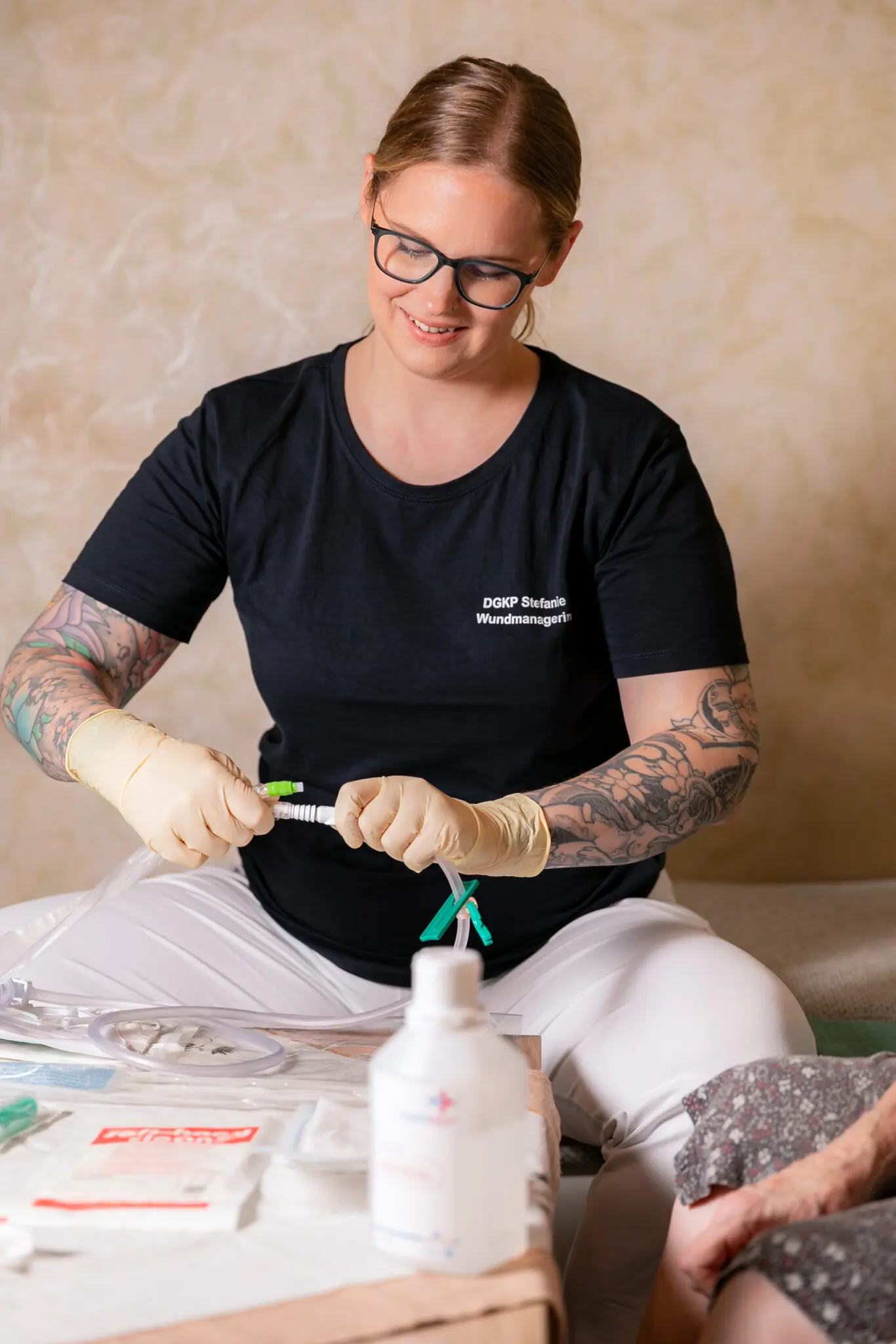
Photo: nurse preparing a catheter change in a home care setting
Where
In your home or in a care home
Duration
approx. 30 minutes incl. preparation and follow-up
How often
usually every 4 weeks
Price
from €54

Catheter change in your home

Our medical home nursing service in Vienna supports you directly in your own home. This way you feel safe and well looked after – without having to travel to a clinic. On a doctor's order, our team inserts the catheter professionally and takes care of regular catheter care and changes. In Vienna, we are your reliable partner for care with a urinary catheter.

Reasons for needing a urinary catheter

A urinary catheter is used for various medical reasons – sometimes for a short time, but often as a long-term (indwelling) catheter. Common causes are urinary retention, for example after operations, with neurological diseases such as multiple sclerosis or with spinal cord injuries that affect bladder function. Incontinence that cannot be treated in any other way can also make a catheter necessary. In urinary retention, for example due to an enlarged prostate, it helps prevent kidney damage. Chronic illnesses often make a long-term catheter unavoidable to protect your health in the long run. In all these cases, professional care and support are essential.

Living with a urinary catheter

Everyday life with a urinary catheter takes a little practice. With the right measures, you can maintain your quality of life. Hygiene comes first: wash your hands thoroughly before every contact with the catheter. Clean the area where the catheter enters the body every day with water and mild soap. Drink enough – this flushes the bladder and helps prevent infections. Empty the urine bag regularly and change it every 5⁠–⁠7 days. Secure the catheter and bag so that you can move freely without pulling or pressure.

Regular checks and changing the catheter on time by our team are important to detect problems early. Our medical home nursing service supports you with practical tips and professional care on site – for more safety and comfort in everyday life.

Care tips

Good to know

01

Hygiene

Regular hand washing and sterile materials

02

Catheter care

Daily cleaning of the catheter entry site

03

Fluid intake

Drink plenty to help prevent infections

04

Mobility

Secure the catheter safely

05

Check-ups

Regular catheter changes by our registered nurse

What patients and relatives say

5.0 from 13 Google reviews

“Ms Schmelzer and her team are absolutely wonderful. They are extremely patient and do perfect work.”

D. L. · Google review, translated from German

“Especially with sensitive issues […] you notice the high level of professional competence. […] great on a human level and absolutely reliable professionally.”

H. K. · Google review, translated from German

“Not only the expertise and the empathetic, friendly manner […], but also the flexibility in finding appointments and the comprehensive advice completely convinced me.”

M. P. · Google review, translated from German

Selected reviews from our Google Business Profile, translated from German (shortened with […]). We have checked that the reviews shown come from people who have experienced our services themselves – as patients, relatives or carers. Partners are labelled. Overall rating: 5.0 out of 5 stars from 13 reviews (as of November 2026). All reviews on Google. Healing outcomes vary from person to person.

Frequently asked questions

How often does an indwelling catheter need to be changed?

A urinary catheter is usually changed every 4 weeks. Your doctor decides the exact timing – depending on the material and the situation. If the catheter is blocked or leaking, it needs to be changed sooner.

Who changes the catheter at home?

Registered nurses are allowed to change the catheter on a doctor's order. We come to your home throughout Vienna and the surrounding area, or to your care home. We plan the next change at the same time.

Do you also change a Cystofix?

Yes. On a doctor's order, we change not only urinary catheters through the urethra but also suprapubic catheters (e.g. Cystofix®) in your home.

How long does a catheter change at home take?

About 30 minutes, including preparation and follow-up.

How much does a catheter change at home cost?

€54 for up to 30 minutes, plus a travel fee from €21. With a doctor's order, the health insurance fund usually refunds approx. 10⁠–⁠15% for home visits, in our experience.

What should I do if the indwelling catheter is blocked or leaking?

Check whether the tube is kinked and whether the bag is hanging below the level of the bladder. If urine still does not drain, or you have pressure and pain in your lower abdomen, call us or your doctor. Outside our hours, the health hotline 1450 can help.

What do I need for the catheter change?

The doctor's order and the catheter material as prescribed, from a pharmacy or medical supply store. We discuss exactly what is needed during the first phone call.

Book an appointment

  • Mon–Fri, 8:30 am – 6 pmavailable by phone
  • Weekends & public holidaysno home visits or clinic appointments; by phone only to make appointments
  • Callbackusually on the same working day
Phone+43 681 10447544E-mailoffice@pflegstro.atWhatsAppSend a messageA Meta service: when you write, data is sent to WhatsApp.

Not an emergency service – in an emergency:

  • 144Ambulanceif life is in danger (or 112)
  • 1450Health hotline24/7 – also tells you the nearest emergency department
  • 141On-call doctorsnights, weekends and public holidays

Request a callback

Just your name and phone number – we will get back to you usually on the same working day.

What is it about? (optional)

Please do not send diagnoses or photos of wounds – we will discuss them in person. Privacy

More topics: Medical home nursing